
The Amazon advertising landscape has changed dramatically over the last few years. What once was dominated by sellers dabbling in campaigns themselves is now a fast-evolving space where professional help is in high demand.
Amazon’s ad business generated over $47 billion in 2024, making it the third-largest digital advertising platform after Google and Meta. That’s not just big—it’s a shift. It means sellers now see ads not as an experiment, but a core part of their growth strategy.
And that’s exactly where an Amazon PPC agency comes in.
This guide is for freelancers, marketers, and eCommerce professionals who want to start their own Amazon PPC agency in 2025. It’s packed with insights, real strategies, and clear direction to help you build a lean, data-driven, and scalable business.
Let’s start with the “why.” Because without the right context, this can seem like just another digital service business.
But Amazon PPC is different.
Here’s what’s happening right now:
That’s where you come in.
An Amazon PPC agency doesn’t require fancy offices, a big team, or a massive budget to start. It can be lean, remote-first, and highly profitable. What matters most is that you know what you’re doing—and you can show results.
Before you take on clients or build an agency website, you need the foundations. You’re not just managing ad spend. You’re managing profit, visibility, and often, the lifeline of a product.
You don’t need to be a guru in all things Amazon, but you do need to know how to run the core ad formats:
Many sellers aren’t using more than one of these effectively. That’s your opportunity.
Amazon PPC has a set of performance indicators you’ll live by:
If you can’t explain these clearly to a client, you’ll have a hard time proving your value.
Start with a lean stack. You don’t need to subscribe to five platforms out of the gate.
Beginner Setup:
Pro Setup:
And most importantly, if you’re planning to scale and acquire clients smartly—use data tools like Seller Contacts. It gives you access to a real database of active Amazon sellers, along with their estimated revenue, product types, and marketplace data. That means less guesswork, more precision in targeting.
One of the biggest mistakes new PPC agencies make is trying to serve “everyone.” That rarely works.
A focused niche helps you speak the seller’s language, build repeatable processes, and create real expertise.
You can filter by:
Sellers in categories like supplements, beauty, or home goods often have higher ad budgets—and greater competition. That means they’re more likely to pay for expert help.
Are you working with private label brands? Wholesalers? Aggregators?
Each has a different structure, margin profile, and ad strategy. Start with one and build from there.
Using Seller Contacts, you can filter sellers by estimated revenue, location, and even product category. You can even sort by brand owners vs resellers, which is critical for targeting the right audience.
This is where a lot of people get stuck. What should you offer? How much should you charge?
A clean offer beats a complex one every time. Here’s what most clients need:
You don’t need to offer everything at once. Start with one strong service and build from there.
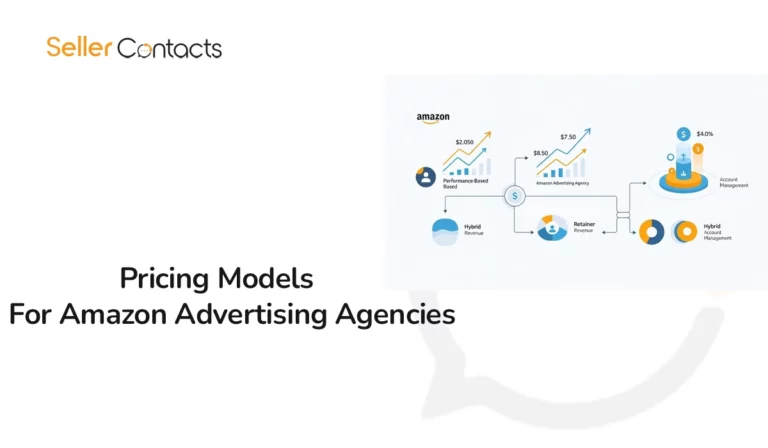
Here’s what the market generally looks like:
| Pricing Model | Description | Typical Range |
| % of Ad Spend | Most common for scaling clients | 10–15% of ad spend |
| Flat Monthly Fee | Predictable revenue, easier for small sellers | $500–$2,000/month |
| Hybrid Model | Base fee + performance bonus | $750 base + % bonus |
| Audit/One-Time Setup | Entry point offer to convert leads | $299–$999 per audit |
Offering tiered packages like Basic, Growth, Enterprise helps clients self-select based on need and budget.
You don’t need to overcomplicate things here, but you do need to look professional.
Start with the basics:
Don’t try to build a big team too early. Focus on delivering quality yourself, then bring on help once your systems are tight.
Let’s get to the part everyone asks: How do I get clients?
You don’t need to run ads or spend thousands. You need data, precision, and good messaging.
This is where Seller Contacts becomes your growth engine. Filter down to sellers in a specific niche, with mid-level revenue, and operating in marketplaces you understand. Then build a prospect list.
Reach out with:
Here’s a sample cold email framework that works:
Subject: Quick idea for your Amazon ads
Hey [Name],
I was reviewing your product listings in the [Category] space and noticed a few ad targeting gaps I’ve seen with similar brands.
I manage Amazon ad campaigns for brands doing $[X]–$[Y] in revenue and usually help lower TACOS by 15–25% in the first 60 days.
Would you be open to a quick audit or performance breakdown? No pitch—just insights.
Cheers,
[Your Name]
Focus on getting that first “yes.” Build results. Turn those into case studies. Everything snowballs from there.
Acquiring a client is hard. Losing one is easy.
Most agencies don’t fail because they can’t get clients—they fail because they can’t keep them.
Here’s how you build long-term relationships that turn into referrals, case studies, and consistent revenue:
Don’t overpromise. Be honest about how long PPC results take. Usually, it takes 30–45 days just to stabilize campaigns. Show clients a 3-month growth plan so they know what to expect.
Weekly check-ins. Monthly performance calls. A quick message when something spikes or dips. Keep clients in the loop—before they ask.
Use Loom videos to walk through reports. It feels personal, and clients appreciate the transparency.
Clients don’t care about a 15-page spreadsheet. They want answers to:
Use simple visuals. Show how ACOS improved. Explain how a new keyword boosted conversions. Make your reporting about decisions, not just metrics.
If you’re just “managing bids,” you’re replaceable. But if you bring strategic ideas—like testing Sponsored Display, launching a new product with aggressive ads, or optimizing the listing to improve CVR—you become a growth partner.
At some point, you’ll hit capacity. You can only run so many campaigns, answer so many emails, and prepare so many reports before burnout hits.
That’s your cue to systemize and scale.
Start with what you do every week.
Write down your process for:
Tools like Notion or ClickUp are great for this. SOPs make it easier to train team members—and give you peace of mind.
Don’t rush to hire a team. But when you do:
Always test with part-time work or a project before making long-term commitments.
Platforms like Scale Insights, ZonTools, Adtomic, or Perpetua allow you to automate bid rules, keyword harvesting, and budget adjustments.
This doesn’t replace human strategy—but it saves time on routine tasks.
One of the biggest unlocks in agency growth is when clients start finding you—not the other way around.
After 60–90 days with a client, ask if you can share results. Highlight where they started, what you did, and the end outcome. Keep it real and results-focused.
You can publish this as a LinkedIn post, Medium article, or use it in your outreach.
You don’t need to be an influencer. Just share lessons from your work:
Be helpful. Be specific. You’ll attract interest.
Consider guest posting on Amazon seller blogs. Join private seller Facebook groups. Attend seller conferences—either in-person or virtually.
If you’re using Seller Contacts, you can also reach out to marketplace coaches and consultants. They often refer clients to reliable PPC managers.
1. Chasing every type of client. Stick to one category or seller profile first. It’s easier to grow vertically than horizontally.
2. Ignoring the product listing. Ads won’t work if the listing is weak. Help clients optimize images, titles, bullets—this boosts CVR and ROAS.
3. Not tracking TACOS. Many sellers only look at ACOS. You need to show how ads impact total revenue, not just paid clicks.
4. Not reading the data. Don’t rely only on ad software suggestions. Look at Search Term Reports, Placement Reports, Budget Cap warnings—this is where real insight lives.
5. Over-automating too early. Don’t let tools do all the thinking. Use automation for routine tasks, but keep your head in the strategy.
To succeed in this space, you need a steady stream of quality leads. Cold outreach still works—but only if it’s smart and data-driven.
That’s where Seller Contacts gives you the edge.
With access to the world’s largest database of Amazon and eCommerce sellers, you can:
No more guessing. Just clean, verified seller data you can act on.